How to Manage Water Runoff in Tiered Yards: Expert Guide to Sloped Drainage
Terraced residential landscapes present unique structural and gravitational challenges when subjected to intense precipitation events. When water moves across multi-level terrain, momentum accumulates rapidly, transforming harmless rainfall into aggressive sheet runoff that scours planting beds and threatens retaining walls. Property owners frequently underestimate the sheer volume of water generated across tiered configurations, discovering too late that unmanaged hydraulic pressure can destabilize masonry and saturate foundation footings.
Addressing these topographical dynamics requires a comprehensive shift away from simple surface drainage toward integrated watershed management. Water must be intercepted, slowed down, filtered, and safely conveyed through each elevation change before it can pool or erode underlying soil matrices. Consequently, mastering how to manage water runoff in tiered yards demands a thorough understanding of soil mechanics, gravitational vectors, and sub-grade engineering principles.
Successful multi-tier water mitigation relies on balancing hard infrastructure with biological absorption. Relying solely on concrete swales or underground corrugated pipes often transfers erosion problems to neighboring boundaries or lower property lines. Instead, resilient landscape designs use cascading infiltration zones, structural catch basins, and reinforced terraces to work in harmony with natural drainage pathways.
Understanding “how to manage water runoff in tiered yards”
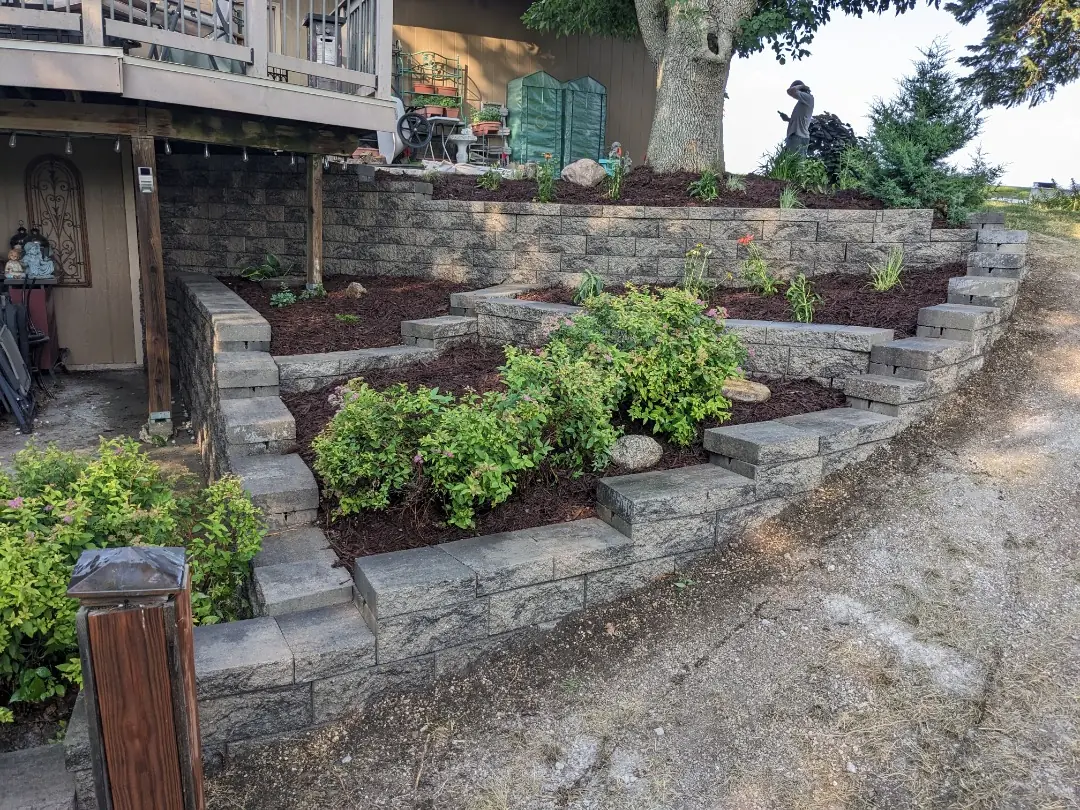
At its core, understanding how to manage water runoff in tiered yards involves analyzing how kinetic energy builds as water flows down stepped elevation changes. A prevalent misconception is that building higher retaining walls automatically solves drainage issues by blocking water movement. In reality, trapping water behind a masonry barrier without adequate behind-wall drainage creates immense hydrostatic pressure, eventually causing the wall to bow, crack, or suffer catastrophic structural blowout.
Oversimplifying sloped water management often leads to localized fixes that exacerbate downstream erosion. For instance, trenching a simple plastic pipe down a slope without energy dissipators at the outfall creates a high-velocity stream that carves deep gullies into the lowest tier. Furthermore, assuming that turfgrass alone can stabilize steep terrace risers ignores the fact that heavy storms easily saturate shallow root zones, triggering destructive mudslides.
A rigorous approach to how to manage water runoff in tiered yards requires treating every individual tier as a micro-catchment basin. Each level must manage its own direct rainfall while safely accepting or bypassing overflow from the tier above it. By distributing water collection across multiple terraces rather than funneling it into a single overloaded conduit, property owners protect structural masonry and preserve precious topsoil.
Deep Contextual Background
The evolution of sloped property management mirrors the history of civil engineering, agricultural terracing, and suburban site development. Ancient agrarian societies mastered slope stabilization through contour farming and stone-lined bench terraces, recognizing that gravity dictates every hydrological intervention. These early systems prioritized slow infiltration and sediment retention over rapid surface evacuation.
During the rapid suburban expansion of the mid-twentieth century, grading practices shifted dramatically. Heavy machinery allowed developers to slice into natural hillsides, creating flat building pads flanked by steep, unstable engineered slopes. This era favored uniform turf lawns and quick-fix corrugated plastic drainage pipes, divorcing site design from local topography and watershed capacity.
In contemporary landscape architecture, tighter municipal stormwater regulations and increasing storm intensity have forced a return to ecologically sensitive slope management. Modern zoning codes frequently prohibit increasing peak runoff rates leaving a property line. Consequently, understanding how to manage water runoff in tiered yards requires navigating strict environmental mandates alongside traditional geotechnical engineering principles.
Conceptual Frameworks and Mental Models
Controlling water across stepped terrain requires robust mental models that clarify how kinetic energy, soil saturation, and volume interact across elevation drops.
The Hydraulic Cascade Model
This framework views a tiered yard as a series of interconnected energy-dissipation zones. Each terrace must capture, slow down, and safely pass surplus water downward without letting velocity compound. If a drop-zone fails to break momentum, the cumulative force at the base of the slope multiplies exponentially.
The Hydrostatic Pressure Equilibrium
This model dictates that water weight behind any retaining structure must be actively relieved through continuous gravel backfills, geotextile layers, and weep holes. Treating a retaining wall as a solid dam rather than a permeable filter guarantees structural failure under saturated soil conditions.
The Infiltration-Before-Conveyance Principle
This mental model prioritizes maximizing on-site soil absorption across upper tiers before routing excess water into hard-piped drainage networks. Encouraging deep percolation reduces the pipe sizing requirements and minimizes downstream municipal infrastructure strain.
-
Limitations of Mental Models: Theoretical hydraulic models assume uniform soil composition and predictable rainfall distribution. Sudden microbursts or hidden layers of impervious clay can instantly overwhelm calculated flow rates.
Key Categories or Variations of Runoff Control Systems
Mitigating water movement across stepped landscapes requires selecting complementary intervention types that address both surface flow and sub-grade saturation.
| Category | Primary Mechanism | Best Suited For | Key Financial Trade-off |
| French Drain Networks | Sub-grade perforated pipe wrapped in geotextile and gravel trenches | Behind retaining walls and saturated turf benches | High material and excavation labor costs |
| Stepped Bioswales | Broad, shallow planted channels running parallel to slope contours | Gentle to moderate slope benches and property borders | Requires ongoing vegetation maintenance and weed control |
| Dry Creek Beds | Rock-lined surface channels that slow and route high-velocity storm surges | Steep ornamental slopes and concentrated runoff zones | High initial stone acquisition and heavy placement labor |
| Terrace Retaining Weep Systems | Integrated pipe outlets and gravel cores built directly into masonry walls | Multi-tiered stone or timber retaining structures | Demands precise installation accuracy during wall construction |
| Rain Gardens on Benches | Depressed basin areas designed to pool and infiltrate storm surges | Wide flat terrace steps with high clay absorption potential | Requires careful sizing to prevent mosquito breeding or prolonged saturation |
| Geomembrane Slope Armoring | Interlocking geocells filled with gravel or soil planted with deep roots | Aggressively steep structural banks and raw cut slopes | High specialized material cost and aesthetic trade-offs |
Decision Logic for Runoff Control Selection
-
Map Surface Flow Vectors: Trace visible water paths during heavy rain to identify where sheet flow transitions into destructive concentrated streams.
-
Evaluate Subsurface Soil Permeability: Conduct percolation tests to determine whether water will infiltrate bioswales or require closed piping networks.
-
Match Structural Capacity: Pair high-volume discharge points with heavy-duty rock aprons or dispersion basins to prevent localized erosion.
Detailed Real-World Scenarios
The practical application of sloped water management varies widely depending on regional climate, soil composition, and architectural layout. The following scenarios illustrate how complex site variables interact.
A : Steep Hillside with Eroding Turf Benches
-
Constraints: A residential backyard drops twenty feet across four narrow turf terraces, washing out mud onto a lower concrete patio during every heavy storm.
-
Decision Points: Choosing between installing expensive underground storm sewer tie-ins versus building stepped stone-lined bioswales across each terrace edge.
-
Failure Modes: Funneling all water down a single unreinforced plastic pipe that clogs with silt and blows apart at the joints under high pressure.
-
Second-Order Effects: Installing rock-armored drop-in basins on each tier breaks water momentum, capturing sediment on-site while transforming an erosion hazard into a terraced garden feature.
B : Retaining Wall Saturation and Bowing
-
Constraints: A series of three-foot timber retaining walls supporting a stepped backyard shows signs of outward bowing and soggy soil pooling directly behind the timbers.
-
Decision Points: Weighing the cost of total wall demolition against retrofitting core drainage pipes and core-drilling weep holes through the existing timbers.
-
Failure Modes: Applying waterproof sealants to the front face of the wall while ignoring trapped water behind it, accelerating structural decay and ultimate collapse.
-
Second-Order Effects: Excavating the upper twelve inches behind the wall to install a gravel-filled French drain relieves hydrostatic pressure immediately, stabilizing the structure without full reconstruction.
C : Clay-Heavy Tiered Yard with Zero Infiltration
-
Constraints: A newly constructed subdivision features compacted clay soil across three backyard tiers, causing water to sit in stagnant puddles for days after rainfall.
-
Decision Points: Deciding between complete mechanical soil aeration and top-dressing versus installing a comprehensive grid of blind drains tied to a sump pump.
-
Failure Modes: Piling topsoil and mulch directly over impermeable clay without breaking the interface, creating a perched water table that rots plant roots.
-
Second-Order Effects: Integrating deep-trench gravel channels combined with gypsum soil amendment breaks the clay barrier, allowing sub-surface water migration toward designated collection points.
D : Urban Townhome Sloped Courtyard
-
Constraints: A narrow, walled multi-tier urban courtyard receives heavy runoff from neighboring properties upslope, threatening to flood the lower basement egress.
-
Decision Points: Weighing the installation of a stainless steel slot drain across the bottom threshold against building a raised permeable paver dry-deck system.
-
Failure Modes: Directing courtyard runoff against neighboring party walls, creating legal liability and structural disputes with adjacent property owners.
-
Second-Order Effects: Installing a heavy-duty continuous linear slot drain tied to a sub-grade sump pump captures migrating water cleanly, protecting the basement entryway without altering architectural lines.
Planning, Cost, and Resource Dynamics
Executing a comprehensive water management plan across tiered topography involves managing complex direct expenditures and hidden lifecycle costs.
Direct Costs
-
Drainage Aggregates: Washed stone, pea gravel, and crushed limestone base delivered in bulk quantities for trench and backfill operations.
-
Perforated Piping and Fittings: Schedule 40 PVC pipes, corrugated HDPE drainage pipe, filter fabric socks, and catch basins.
-
Masonry and Wall Materials: Concrete blocks, landscape timbers, structural geogrid fabric, and anchoring spikes for retaining structures.
Indirect and Opportunity Costs
-
Heavy Excavation and Soil Removal: Tipping fees and transport costs for excess clay and soil excavated during trenching and swale shaping.
-
Professional Engineering Oversight: Retaining civil engineers or hydrologists to calculate watershed capacities for properties with extreme slopes.
-
Landscape Restoration Labor: Re-establishing turf, groundcovers, and planting beds disturbed by heavy trenching equipment.
| Project Phase / Scope | Typical Cost Variance (%) | Primary Cost Driver | Optimization Leverage |
| Site Hydrological Mapping | 5% – 15% | Surveying equipment & engineering consultation | Detailed self-mapping during active storm events |
| Subsurface Trenching & Excavation | 20% – 35% | Equipment rental duration & soil hardness | Strategic manual hand-digging for tight tier spaces |
| Drainage Materials & Piping | 25% – 40% | Pipe diameter, aggregate volume, & filter grade | Direct quarry sourcing for bulk gravel and stone |
| Terrace Stabilization & Softscaping | 20% – 30% | Plant plug volume, turf repair, & stone work | Phased planting schedules using starter plugs |
Tools, Strategies, and Support Systems
Executing sloped water management requires specialized field tools, precise measuring equipment, and robust operational strategies.
-
Rotary Laser Levels: Precision leveling instruments required to establish exact downhill slope percentages (typically a minimum 1% to 2% fall for drainage pipes). Limit: Line-of-sight blockages by mature vegetation or sharp tier drops require multiple setup points.
-
Percolation Test Kits: Cylinders used to measure how fast water drains into sub-grade soils, determining whether infiltration basins will function. Limit: Results vary wildly depending on seasonal soil moisture and antecedent rainfall.
-
Mini-Excavators and Trenchers: Compact machinery designed to navigate narrow backyard gate openings and cut drainage trenches across tight terrace steps. Limit: Heavy tracks cause severe soil compaction and turf destruction on steep slopes.
-
Geotextile Non-Woven Fabrics: Porous synthetic fabrics that allow water to pass while filtering out fine silt particles that clog gravel beds. Limit: Using cheap woven fabrics instead of non-woven material leads to premature silt clogging.
-
Sump Pumps and Battery Backups: Mechanical pumps housed in collection basins to lift water from lower tiers up to street-level storm sewers. Limit: Dependent on continuous electrical supply; failure during severe storms causes immediate flooding.
-
Trench Compactor Rammers: Specialized vertical compaction tools used to densify soil backfill over buried drainage pipes, preventing future sinkholes. Limit: Over-compaction directly over plastic pipe crowns can crush conduits if not properly bedded in sand.
Risk Landscape and Failure Modes
Failing to account for hidden hydraulic risks in sloped landscapes can lead to severe structural failures and costly property remediation.
-
Under-Sizing Drainage Conduits: Installing small 3-inch corrugated pipes that lack the volumetric capacity to handle heavy cloudbursts. Mitigation: Calculate peak watershed volume using local rainfall intensity data and install minimum 4-inch or 6-inch rigid Schedule 40 PVC lines.
-
Discharging Water Onto Neighboring Slopes: Piping concentrated roof and terrace runoff directly onto an adjacent lower property boundary. Mitigation: Route all collected water into municipal storm connections, approved on-site dry wells, or dispersed level spreaders.
-
Omitting Filter Fabric in Trench Systems: Backfilling gravel directly into clay soil trenches without wrapping the trench in non-woven geotextile. Mitigation: Completely line all drainage trenches with filter fabric to prevent surrounding clay from migrating into the gravel voids.
-
Ignoring Freeze-Thaw Pipe Displacement: Burying drainage outlet pipes too shallowly in northern climates where freezing standing water splits the conduit. Mitigation: Pitch all pipes continuously to prevent standing water accumulation and bury lines below regional frost lines where feasible.
Governance, Maintenance, and Long-Term Adaptation
A functional water management system on tiered terrain requires ongoing inspection and preventative maintenance to prevent catastrophic blockages.
Monitoring and Review Cycles
Property managers should conduct comprehensive drainage audits twice annually—specifically before the spring thaw and prior to the heavy autumn storm season. Additional spot checks should occur immediately following major tropical storms or severe cloudbursts.
Adjustment Triggers
-
Catch Basin Silt Accumulation: Sediment filling more than twenty-five percent of a catch basin sump indicates the need for manual cleanout and upstream erosion control.
-
Slow Drainage in Swales: Water standing in bioswales longer than forty-eight hours signals soil compaction, organic choking, or clogged under-drains.
-
Retaining Wall Weep Hole Blockage: Mineral crusting or water pooling behind walls where weep holes have ceased discharging indicates internal pipe calcification.
Layered Maintenance Checklist
-
[ ] Clear organic debris, leaves, and twigs from all surface catch basin grates and channel drain covers monthly.
-
[ ] Flush underground drainage PVC pipes with a high-pressure sewer jetter nozzle annually to remove root intrusion and silt buildup.
-
[ ] Inspect retaining wall weep holes and clear mineral deposits using a rigid wire probe or compressed air.
-
[ ] Replenish washed stone in dry creek beds and bioswales where high-velocity water has displaced aggregate.
-
[ ] Monitor terrace slope vegetation density, patching bare soil patches with deep-rooting groundcovers to prevent surface erosion.
Measurement, Tracking, and Evaluation
Assessing the performance of a tiered drainage system requires pairing qualitative visual observation with quantitative hydrological metrics.
Leading vs. Lagging Indicators
-
Leading Indicators: Soil infiltration rates, catch basin flow velocity, and root-zone moisture uniformity across terrace benches. These metrics predict system resilience before failure occurs.
-
Lagging Indicators: Frequency of basement water intrusion, volume of eroded topsoil replaced annually, and structural movement measurements on retaining walls. These metrics evaluate historical performance.
Qualitative vs. Quantitative Signals
-
Qualitative Signals: Clear, silt-free water discharging from outfall pipes, absence of standing water on turf benches twenty-four hours post-storm, and stable masonry joints.
-
Quantitative Signals: Gallons of water captured per storm event, linear feet of trench cleared annually, and total maintenance labor hours expended on drainage upkeep.
Documentation Examples
-
System As-Built Blueprint: Detailed digital schematics mapping exact pipe depths, cleanout locations, and catch basin elevations across all property tiers.
-
Stormwater Event Log: A chronological record tracking rainfall intensity, standing water locations, and drainage system response times during major weather events.
-
Maintenance Ledger: An itemized log recording pipe jetting dates, filter replacements, and structural wall inspection notes.
Common Misconceptions and Oversimplifications
-
Myth: Water naturally flows downhill, so simply sloping the ground away from the house solves all drainage problems.
-
Correction: Uncontrolled sheet flow across tiered yards accelerates in velocity, stripping topsoil and overwhelming lower foundations without structured collection channels.
-
-
Myth: Perforated drainage pipes do not need cleanout ports if they are buried underground.
-
Correction: Silt, root intrusion, and iron bacteria inevitably clog underground pipes; accessible cleanout elbows are mandatory for long-term maintenance.
-
-
Myth: Retaining walls hold back soil, so drainage is only an optional cosmetic add-on.
-
Correction: Saturated soil behind a retaining wall doubles lateral hydrostatic pressure, causing structural collapse unless continuous gravel backfills and weep systems are present.
-
-
Myth: Corrugated flexible black plastic pipe is just as durable as rigid Schedule 40 PVC for underground drainage.
-
Correction: Flexible corrugated pipe sags, collects debris in its ridges, and is easily crushed by heavy soil loads or mechanical tampers compared to rigid PVC.
-
-
Myth: Planting dense turfgrass on steep slopes eliminates the need for physical runoff control.
-
Correction: Shallow turf roots cannot anchor soil against intense sheet flow on steep grades, resulting in massive mud slip events during severe storms.
-
-
Myth: Dry creek beds are purely decorative garden features that require no engineering capacity.
-
Correction: A properly functioning dry creek bed must be sized with appropriate width, depth, and stone gradation to handle high-velocity volumetric surge without overflowing its banks.
-
Ethical, Practical, and Environmental Considerations
Managing water runoff across residential property lines carries significant civic and environmental responsibilities. Unengineered drainage solutions that dump concentrated storm surges onto neighboring properties or public roadways violate municipal codes and strain public infrastructure. Furthermore, directing unfiltered urban runoff loaded with lawn fertilizers, pesticides, and heavy silt directly into local streams damages downstream aquatic ecosystems. Sustainable slope water management embraces ecological stewardship by utilizing on-site bioswales, rain gardens, and permeable sub-grade infiltration basins to filter pollutants, recharge local groundwater aquifers, and protect regional watersheds. True property authority is defined by balancing personal landscape protection with complete environmental responsibility.
Conclusion
Controlling water across stepped landscapes requires rigorous engineering discipline, an understanding of soil mechanics, and meticulous long-term maintenance. By prioritizing sub-grade infiltration and energy-dissipating flow paths over simple surface diversion, property owners protect structural masonry and preserve precious topsoil. Ultimate success in slope management is achieved through patience, structural integrity, and respect for site hydrology, ensuring that every invested resource secures enduring functional and environmental value.